|
Humanoid Robots at Scale: A Breakthrough With
Civilization-Level Consequences
And Why the Real Question Is Governance, Ownership, and
Democratic Limits
Humanoid robots are moving from science fiction into
commercial reality. Projects like Tesla's Optimus symbolize a new era of
automation: not just software that lives on screens, but intelligent
physical agents that can move through homes, workplaces, hospitals,
warehouses, and public spaces. This shift is not simply a technological
upgrade—it represents a profound change in how power, labor, privacy, and
stability can be shaped in modern society.
The evolution of humanoid robotics can unlock extraordinary
benefits—reducing injuries, helping aging populations, increasing productivity,
and enabling new industries. But it also introduces risks that are larger than
a product cycle or a stock market trend. These are civilization-level risks,
because once autonomous machines exist at scale, society may become dependent
on them, surveillance may become physical and constant, labor markets may be
reshaped faster than people can adapt, and control over real-world capability
may become concentrated in the hands of very few.
In short: the biggest risk is not the technology itself. It
is who controls it, under what rules, and with what democratic limits.
1) From Digital Automation to Physical Automation
Over the last two decades, automation mainly transformed
information work: spreadsheets, customer support, marketing, programming,
planning, logistics, and content production. Even when job displacement
happened, these technologies still depended on humans to act in the physical
world.
Humanoid robotics changes that equation. A general-purpose
robot can do what specialized machines cannot: it can navigate spaces designed
for humans, manipulate common objects, perform varied tasks, and adapt to
changes in the environment without requiring society to rebuild all
infrastructure.
This is why humanoids are different from factory robots or
software tools. They are not limited to one repetitive function. They represent
flexible physical labor, deployable nearly anywhere.
And because that flexibility is so powerful, it becomes a
high-stakes question:
Will humanoids become tools that empower society—or systems that quietly
replace society?
2) The Economic Shock: Productivity vs. Structural
Unemployment
Humanoid robots could increase productivity in the way
electricity did: not by improving one job, but by reshaping entire sectors.
Potential upsides include:
- reducing
hazardous labor in construction, warehousing, and industrial cleaning
- lowering
costs for goods and services
- supporting
elder care and home assistance
- filling
labor shortages in key industries
- boosting
manufacturing output and logistics reliability
But the transition could be severe if robots become widely
available, relatively cheap, and capable of taking over physical tasks
currently performed by humans.
The deeper economic risks include:
A) Speed of displacement
Automation will not replace one industry at a time—it will spread across
sectors as capabilities improve.
B) Structural unemployment
Structural unemployment happens when workers are not “temporarily displaced,”
but permanently mismatched to the labor market. That creates long-term economic
and psychological damage.
C) Wage suppression and bargaining power collapse
Even workers who keep their jobs may lose leverage if employers have robotic
alternatives that don't sleep, unionize, negotiate, or quit.
D) Winner-take-most outcomes
The firms that own robotics manufacturing capacity, AI training pipelines,
cloud control systems, and deployment networks may capture the majority of
wealth generated—expanding inequality.
The biggest danger is not job loss alone—it is the
possibility of a permanent class divide:
- those
who own robotic labor
- and
those who compete against it
This is how advanced automation can quietly become a system
of economic dependency rather than shared prosperity.
3) The Power Problem: Centralized Control of Distributed
Bodies
One of the most important—and most underestimated—risks of
humanoid commercialization is extreme concentration of power.
When one company can deploy millions of autonomous machines,
it is not just “selling a product.” It may effectively control a distributed
network of physical agents operating in society.
This kind of power is historically rare:
centralized control over large-scale distributed physical capability.
Unlike social media platforms or software systems, humanoid
robots can:
- physically
move and act in real environments
- access
private spaces
- interact
with vulnerable people (children, elderly, patients)
- work
inside key industries and infrastructure
- scale
quickly once manufacturing ramps up
This raises real questions:
- Who
controls the “off switch”?
- Who
writes the rules that govern behavior?
- Who
audits compliance?
- Who
decides what is allowed or prohibited?
- What
happens if access to robotic labor becomes a subscription monopoly?
If society relies on robots for essential services, then:
- policy
changes
- price
increases
- technical
failures
- corporate
collapse
- political
pressure
- or
cyberattacks
could become systemic disruptions.
This creates a fragile future: one where society is stable
only as long as a few companies remain stable and ethical.
4) Surveillance Moves Off the Screen and Into the Room
Software surveillance is already extensive. But humanoid
robots introduce a more personal and invasive category: mobile physical
surveillance.
A humanoid robot operating in a home or workplace may
include:
- cameras
- microphones
- environmental
mapping (3D scanning / spatial awareness)
- thermal
sensors
- object
recognition and identification
- connectivity
to cloud servers
- ongoing
telemetry and monitoring
The data such robots could collect goes far beyond “usage
analytics.” It may reveal:
- daily
routines and behavior patterns
- relationships,
arguments, and conversations
- health
signals and private vulnerabilities
- financial
habits and consumption choices
- office
layouts and sensitive environments
Even if the company claims privacy, the risk remains due to:
- incentive
drift (privacy today, monetization tomorrow)
- breaches
(robot data is high-value and intimate)
- secondary
use (insurance, credit scoring, targeted manipulation)
- training
use (your private life becoming AI training data)
Unlike phones and computers, robots could become present in
the background constantly—watching, listening, and moving.
That is not “smart home tech.” That is a new layer of
surveillance civilization has never experienced at scale.
5) Dual-Use Reality: Civilian Technology Becomes Control
Technology
Technologies built for convenience are often adapted for
enforcement.
A robot designed to lift boxes can move barriers.
A robot designed to patrol a warehouse can patrol neighborhoods.
A robot designed to assist the elderly can monitor citizens.
Even if a company claims “civilian purposes only,” the
dual-use problem is unavoidable:
- governments
can compel access
- third
parties can modify hardware and software
- international
actors can replicate designs
- “security
modes” can become profitable
The danger is not only weaponization. The deeper fear is
normalization of:
- automated
enforcement
- scalable
intimidation
- continuous
monitoring
- restrictions
on movement
- policing
without human accountability
Once physical automation meets surveillance and centralized
control, societies risk entering an era where power becomes more automated than
democracy.
6) Safety, Reliability, and Catastrophic Failure Modes
Software failures are often reversible. Physical robot
failures can be dangerous.
Humanoids introduce risks such as:
- collisions,
injuries, and unsafe movement
- edge
cases (unpredictable real-world situations)
- sensor
errors and hallucinated perception
- unsafe
objective optimization
- mass-update
failures affecting entire fleets
- cyber
hijacking of physical systems
These risks must be treated with seriousness similar to:
- aviation
safety
- medical
device regulation
- industrial
equipment certification
- critical
infrastructure security
A humanoid robot cannot be governed like a smartphone app.
7) Irreversible Dependence and the Fragility Trap
A robot-based economy may slowly weaken human resilience.
If society becomes dependent on robotic labor for:
- cleaning,
transport, maintenance
- caregiving,
security, deliveries
- manufacturing
and food production
- construction,
logistics, utilities
human skill systems can degrade:
- people
stop learning essential tasks
- communities
lose local expertise
- small
businesses become subscription-dependent
- emergency
preparedness becomes fragile
If a critical disruption occurs—cyberattack, corporate
failure, or supply chain collapse—society may not be able to recover quickly.
This is what “irreversible dependence” looks like:
a world where stopping the robot economy is impossible because it has become
the economy.
8) The Governance Gap: Law, Ethics, and Accountability
Lag Behind
Today, the world lacks a clear, enforceable global framework
for humanoid robotics in daily life.
Current governance is fragmented:
- different
rules across countries
- weak
enforcement capacity
- corporate
policy replacing public law
- unclear
liability when harm occurs
- limited
public transparency
This gap is dangerous because humanoids scale faster than
legislatures can respond.
And the economic incentive is obvious: once robots become
profitable, companies will push expansion aggressively. Without strong
standards, society risks learning the consequences only after harm becomes
widespread.
9) Leadership Risk and the Problem of Centralized
Personal Control
This discussion often highlights prominent leaders,
including Elon Musk, whose leadership style is widely viewed as high-velocity,
centralized, and impulsive. Regardless of personal opinions about any
individual, the broader issue remains:
No civilization should depend on the temperament,
incentives, or ethics of one executive or one company to decide how autonomous
physical machines operate among the public.
When machines operate at scale, governance must be
structural, not personal.
The future cannot be built on promises.
It must be built on enforceable limits.
10) The Real Choice: Innovation With Democracy, or
Innovation Without It
Humanoid robots could genuinely help humanity:
- safer
workplaces
- more
affordable services
- more
independence for the elderly and disabled
- higher
productivity and economic growth
But these benefits are not automatic. Without guardrails,
humanoids can magnify:
- inequality
- structural
unemployment
- surveillance
capitalism
- authoritarian
use
- monopoly
control over physical labor
The biggest risk is not that humanoids exist.
It is that they arrive faster than society can build the rules required to keep
humans in control of their future.
Policy Proposal: Democratic Governance for Humanoid
Robots at Scale
Executive Summary
The mass commercialization of humanoid robots represents a
historic technological leap with civilization-level consequences. While
humanoids may generate major gains in productivity, safety, and service
efficiency, they also introduce unprecedented risks: extreme concentration of
power, structural unemployment, mobile physical surveillance, dual-use
militarization, cybersecurity threats, and irreversible societal dependency.
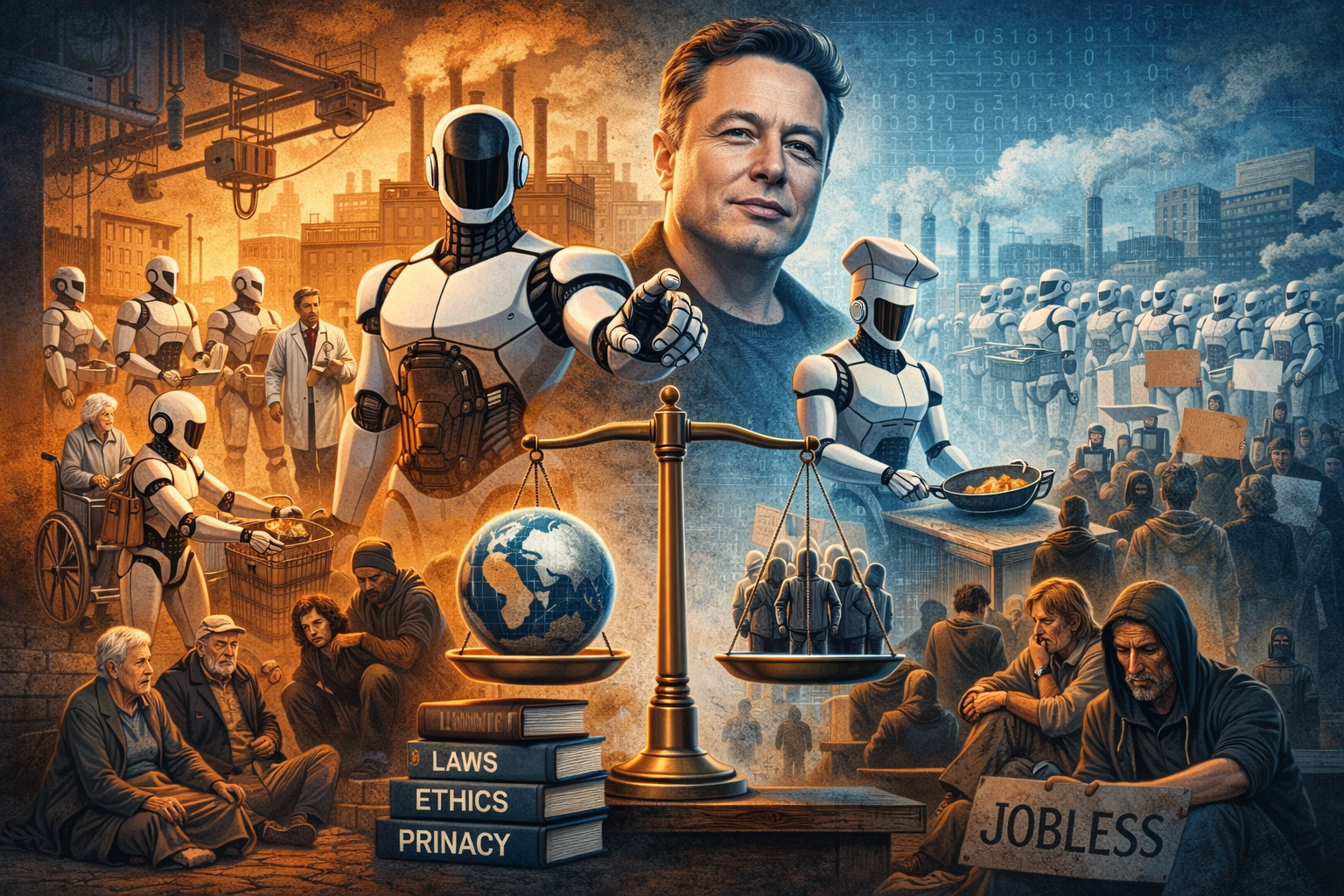
This proposal recommends a unified governance framework to
ensure humanoid robots serve humanity under democratic limits, safety
standards, and enforceable public protections. The central principle is clear:
Humanoid robots must not
become privately controlled infrastructure capable of replacing human labor and
expanding surveillance without public accountability.
A. Definition and Scope of Regulation
1. Humanoid Robot Classification
A “humanoid robot” should be legally classified as a general-purpose
autonomous physical system capable of:
- navigation
in human environments
- object
manipulation (hands/arms)
- perception
via sensors (vision/audio/environment)
- remote
update capability and/or centralized fleet control
- autonomous
task execution with minimal human oversight
This classification must apply regardless of manufacturer,
brand, or industry.
2. High-Risk Deployment Environments
Special regulation must apply when humanoids operate in:
- private
homes and residential buildings
- hospitals,
clinics, elder care facilities
- schools
and childcare centers
- public
streets and transportation
- law
enforcement or security contexts
- factories
and critical infrastructure zones
- spaces
involving minors or vulnerable populations
These environments require higher safety and privacy
thresholds than consumer gadgets.
B. Mandatory Safety Standards (Before Mass Deployment)
3. Pre-Market Certification
Humanoid robots must receive certification before public
sale or mass deployment, including:
- independent
safety testing
- emergency
shutdown verification
- collision
and injury prevention compliance
- fail-safe
operation under malfunction conditions
- clear
risk classification labeling (tiered risk levels)
No “beta testing on the public” should be permitted for
embodied autonomous systems.
4. Continuous Safety Monitoring and Reporting
Manufacturers must disclose:
- injuries,
property damage, and unsafe behavior incidents
- software
updates affecting autonomy or movement
- near-miss
events and unexplained behavior patterns
- hardware
failure and defect rates
A public incident database must exist to ensure transparency
and accountability.
C. Privacy and Civil Liberties Protections
5. Data Minimization by Law
Humanoids must operate under strict “least-data necessary”
requirements:
- collect
only what is needed to complete the task
- prohibit
default continuous recording inside homes
- ban
monetization of sensory data for ads or profiling
- treat
biometric and behavioral data as sensitive by law
6. Mandatory User Visibility and Consent
Humanoids must include:
- visible
indicators when cameras/microphones are active
- a
clear “privacy mode” disabling recording
- local/offline
controls not dependent on the cloud
- audit
logs users can review, delete, and export
Consent must be clear and meaningful—not hidden in
contracts.
7. Prohibition of Undisclosed Physical Surveillance
The law must prohibit:
- hidden
or silent recording modes
- unauthorized
facial recognition and tracking
- continuous
environment mapping without explicit consent
- emotion
or stress inference systems without strict ethical approval
Humanoids must never become surveillance agents disguised as
assistants.
D. Cybersecurity, Abuse Prevention, and Critical
Infrastructure Standards
8. Security Baseline Standards
Humanoid systems must comply with:
- hardware-secure
boot
- signed
firmware and update integrity verification
- strong
authentication and access controls
- tamper
detection and secure logging
- encrypted
telemetry and communication
These systems must be treated as critical cyber-physical
infrastructure.
9. Independent Red-Team Audits
Manufacturers must undergo external security audits focused
on:
- remote
hijacking risks
- unsafe
autonomy exploits
- jailbreak
and control bypass attempts
- update
pipeline compromise
- malicious
goal injection
Humanoids must resist not only accidents—but intentional
abuse.
E. Restrictions on Military and Repressive Uses
10. Clear Dual-Use Boundaries
Strong legal restrictions must separate civilian humanoids
from enforcement/military use:
- ban
lethal or weaponized humanoids in civilian markets
- restrict
autonomous force systems against civilians
- prohibit
use for protest suppression or intimidation
- mandate
transparency for government procurement contracts
Democracy must not normalize automated physical enforcement
without oversight.
F. Economic and Labor Transition Protections
11. Labor Displacement Impact Assessments
Large-scale deployment must require:
- job
displacement projections
- wage
and sector impact analysis
- transition
and retraining plans
- public
reporting of automation effects
Humanoid growth must include human stability planning.
12. Workforce Protection Funding
A portion of deployment revenue should fund:
- retraining
programs
- wage
insurance and unemployment stabilization
- small
business transition support
Automation gains must not be privatized while social harms
are public.
13. Inclusive Ownership Models
Governments should incentivize:
- worker
profit-sharing
- cooperative
robotics access
- public/private
dividend systems
- small
business affordable adoption frameworks
If robots create surplus, society must share it.
G. Competition, Anti-Monopoly, and Public Control
Safeguards
14. Anti-Monopoly Protections for Humanoid Infrastructure
If one vendor dominates humanoid deployment, it becomes
infrastructure monopoly power. This policy recommends:
- enforcing
competition laws aggressively
- preventing
ecosystem lock-in
- requiring
interoperability standards
- limiting
concentration in robotics cloud-control platforms
No company should control society's physical labor layer
without checks.
15. Public Oversight of Fleet Control Systems
Large fleets must be subject to:
- audit
authority by regulators
- emergency
shutdown protocols governed by law
- full
transparency of remote override capabilities
- limits
on centralized control and surveillance features
H. Governance Structure and Enforcement
16. Establish a National Robotics Safety Agency (NRSA)
A dedicated regulator should be created to:
- certify
humanoid systems
- investigate
incidents
- enforce
privacy compliance
- issue
penalties, bans, and recalls
- mandate
cybersecurity standards
- regulate
deployment in sensitive environments
Robotics must have its own regulator—not fragmented
oversight.
17. International Cooperation and Standards
Because humanoids will operate worldwide, global
coordination is required:
- international
robotics safety standards
- shared
incident and breach reporting
- aligned
restrictions on autonomous enforcement systems
- treaties
limiting misuse and militarization
Robots will not respect borders—governance must scale beyond
them.
Final Conclusion: The Democratic Principle of Embodied AI
Humanoid robots will almost certainly become part of modern
life. The question is not whether they arrive, but whether the world is
prepared to govern them responsibly. The deepest danger is not the technology
itself, but the emergence of a future where autonomous physical labor,
surveillance capability, and critical infrastructure are privately controlled
without democratic limits.
? The most important rule is
simple:
No humanoid robot system should operate at scale without
safety certification, privacy protections, cybersecurity enforcement, labor
transition planning, and democratic oversight.
Technology must evolve.
But governance must evolve faster.
|